

The views expressed are solely my own and do not represent the official position of YEI, a nonpartisan think tank that provides a platform for its researchers to share independent perspectives.
Flags with colonial roots and “Made in China” tags hung over their shoulders, Sydney’s youth spent their Sunday demanding to “take Australia back”. Contrary to the initial “not hateful” descriptions by the organisers, the “March for Australia” rallies that swept across major cities on 31 August were led by Neo-Nazis shouting “Heil Australia”, chanting for utopic fantasies of a white Australia that go far beyond simple patriotic defences against immigration [18]. Eventually when the lunch hour rolled around, a group of these self-styled guardians of national purity headed off for lunch to the country’s cult favourite, a fine example of authentic Australian cuisine: a yum cha restaurant. Flags still tied around their shoulders like superhero capes, they sat tucking into dumplings and spring rolls, the very cuisine of a community they had spent the day denouncing [12].
It would be funny if it were not so telling. The contradiction captures the hollow core of far-right nationalism: a movement that claims to protect an imagined cultural purity while surviving on the richness of the very global interconnections it rejects. And it is not just an Australian spectacle. From the United States to Europe, the rise of far-right extremism has become a global pattern, fuelled less by cultural threat than by economic anxiety. The August rallies in Sydney, Melbourne, Adelaide, Brisbane and Canberra are the latest expression of a politics that thrives on grievance, scapegoating and irony.

The Paradox of Far-Right Identity
What August 31st revealed is not simply hypocrisy but dependency. Movements that posture as defenders of a pure, self-sufficient nation are tethered to global currents they cannot escape: imported goods, migrant labour, multicultural cities, international capital. Their identity is performed through denial, clinging to symbols of sovereignty while living in the everyday reality of interconnectedness.
This dependency creates a paradoxical energy. On one hand, the far-right attempts to cultivate through exclusion, manufacturing an ‘us’ by vilifying a ‘them.’ On the other hand, its material practices betray just how porous and hybrid ‘us’ already is. The flag-caped marchers do not just borrow foreign cuisine, they embody a national identity that has always been syncretic, stitched together through migration, trade and exchange. The irony of dumplings after anti-immigrant chants is the truth of the nation laid bare.

The Housing Crisis Misdiagnosed
The rallies misdiagnose the crunch. Australia is adding homes too slowly to meet underlying demand. The National Housing Supply and Affordability Council’s 2025 report estimates only 177,000 dwellings were completed in 2024 against an underlying demand of about 223,000. It also forecasts around 938,000 completions by mid-2029 against the 1.2 million target [24][25]. Shortfalls of this size do not yield to slogans.
Upstream indicators point the same way. Building approvals in July 2025 fell 8.2% month-on-month while approvals for apartments fell 22.3% [4]. A construction sector plagued by insolvencies and thin margins cannot scale on command.
Demand has stayed firm. Net overseas migration was 446,000 in 2023–24, down from the post-reopening peak but still elevated by historical standards [3]. The largest arrival group was international students (207,000) [3], who rent rather than buy and whose spending underwrites universities and local economies. Population flows interact with the shortage; they do not cause it.
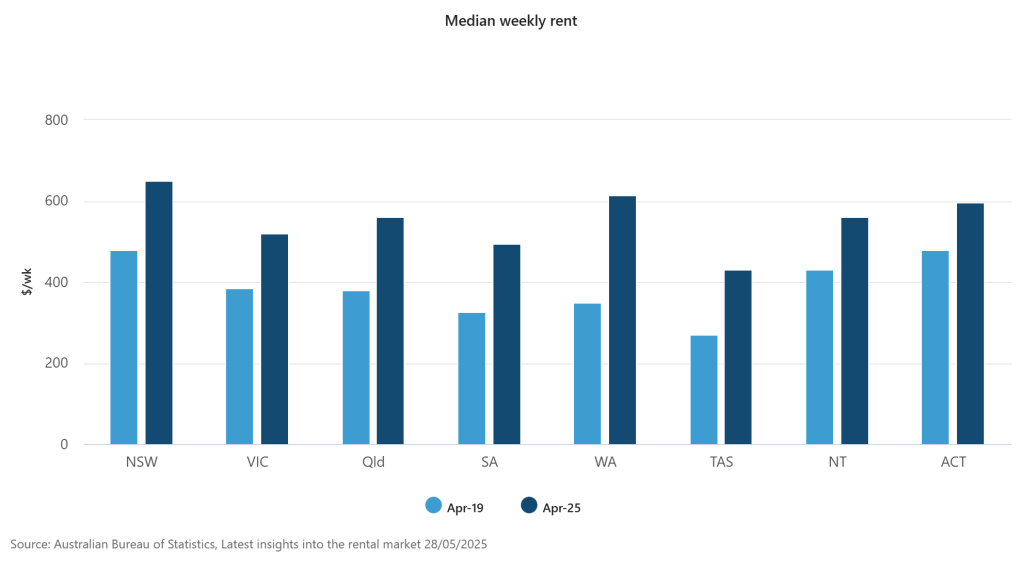
The rental squeeze has not lifted. By the June quarter for 2025, CPI rent inflation slowed to 4.5% year-on-year, but the Reserve Bank reports that advertised rents in the capital cities have picked up again, making a sharp easing unlikely until new housing comes online [27]. Approvals, meanwhile, have shown little response to interest rate cuts, leaving the supply pipeline thin [27]. Average household size has returned to pre-pandemic levels, which dampens demand at the margin, yet underlying demand continues to grow with population increases [27]. Market readings confirm the pressure: national vacancy rates remain well below balanced levels, keeping bargaining power with landlords [16]. The message from the data is consistent: unless building rates pick up, high rents will persist.
The pressure shows up where renters live. National rental vacancy rate hovered near 1.2% in May 2025, a level consistent with landlord leverage and little bargaining room for tenants [31]. ABS data shows rents rose sharply from 2021 and remain well above pre-COVID levels, even as the pace of increases began to slow late-2024 [5].

How the Right-Wing Skews Reality
The promise is seductive: seal the border, expel newcomers, and the housing market will heal. It treats a migration lever as if it were a construction policy. Borders can change who queues for scarce rentals; they cannot lift completions, fix builder balance sheets, or shorten planning timelines.
The skew works through a few moves. First, causal substitution: structural bottlenecks in approvals, finance and productivity are recast as a problem of “too many people”. Second, numerator games: gross arrival numbers are spotlighted, while the relevant measures for housing are net household formation, completions and time to delivery. Third, snapshot politics: a price spike in inner-city rentals is narrated as a system-wide failure caused by migrants, while the long pipeline from approvals to keys is ignored.
There is also a politics of beneficiaries. High rents enrich property cartels and asset holders. Land banking appreciates in value when supply is slow. Tax settings and weak renter protections keep returns attractive. A border story that points at migrants is useful here because it keeps attention away from those who profit from scarcity.
The real-world check is simple. Net overseas migration fell back in 2023–24, yet rents remained high and advertised rents in the capitals began rising again. Approvals have not meaningfully lifted, and the supply pipeline is still thin. Data reads the market as tight until new stock arrives, not until a slogan is shouted.
In one line: housing pressure is produced by slow supply and distorted incentives; cutting migration does not build homes or shift those incentives.

Scapegoating as Strategy
The far-right does not drift into this narrative; it engineers it. Housing stress, insecure work and rising bills are real pressures, but instead of confronting their structural causes, extremists redirect them onto migrants. Grievance then becomes a mask for ideology.
The “March for Australia” rallies made this visible. The National Socialist Network (NSN) is the activist branch of the political organisation ‘White Australia’, which did more than simply attend the rallies. They choreographed the optics, where tens of thousands of protestors ended up being used to channel NSN’s ideology of “proud racism” [22]. In Sydney, they marched at the front beneath an “End mass-immigration now” banner. In Melbourne, their leader took the microphone. In Adelaide, their insignia was displayed without disguise. Internal recruiting notes stress “social proof”, meaning that large crowds are presented as evidence of legitimacy. Organisers even scrubbed terms like “remigration” from websites, replacing them with “Australian heritage,” a linguistic laundering that conceals exclusion beneath patriotic varnish [21].
NSN’s mobilisation notice, circulated in the lead-up declared: “it is important that our supporters demonstrate to the government and public that White Australians are fed up with endless immigration” [34]. Supporters were invited to network with members wearing their uniforms of all-black attire. Ahead of the rally on 9 August at about 12:40 am, around 150 NSN members with faces covered, marched through Melbourne’s CBD, carrying banners of “White Man, Fight Back” [32].
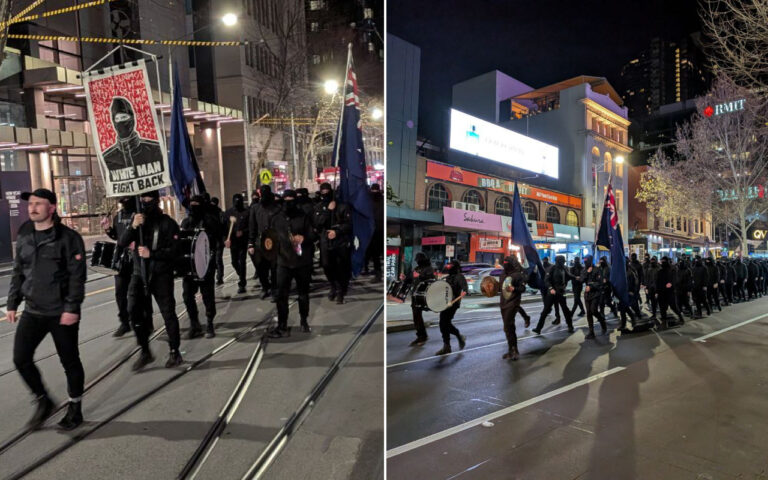
This matters because it shows how easily diffuse economic anxieties can be hijacked by extremist movements with an entirely different agenda. People worried about rent or job security find themselves shoulder-to-shoulder with men who dream of a White Australia, even though the nation’s very foundations are those of a melting pot. Legitimate economic frustration is funnelled into the service of a supremacist fantasy, enabling the growth of fascism.
The events in Melbourne laid this danger bare. On 31 August, NSN members including leader Thomas Sewell, broke away from the main protest to storm Camp Sovereignty, a sacred Aboriginal site of resistance. There, women were assaulted and two were hospitalised [19]. What began as a rally wrapped in patriotic slogans ended as an attack on Indigenous sovereignty itself. It is a reminder that scapegoating is never abstract or harmless. Once legitimised in the public square, it translates swiftly into violence against those already marginalised.
Global Parallels
Australia is not exceptional in this drift. On a global scale, far-right movements have mastered the same choreography: convert real issues into cultural panic, disguise ideology as patriotism, and radicalise the everyday into an existential struggle.
The UK
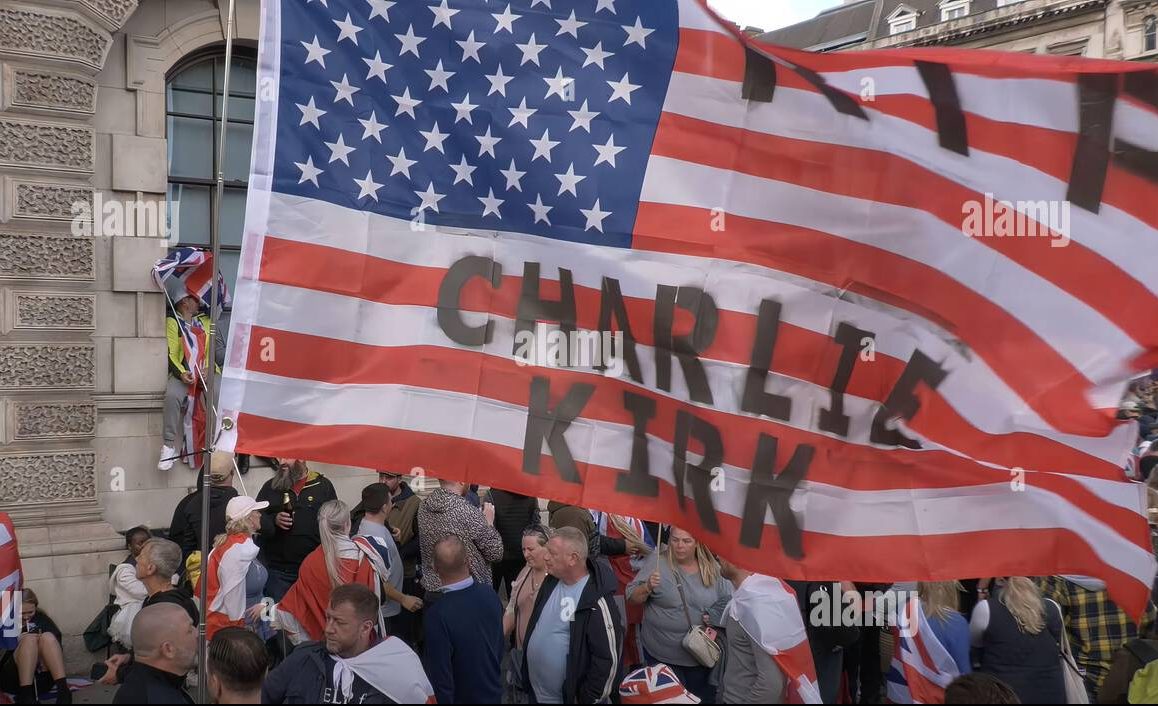
In Britain, immigration has become both lightning rod and theatre. The tabloids obsess over small boats crossing the Channel, while asylum backlogs leave tens of thousands warehoused in hotels at public expense. The government’s Rwanda deportation scheme, presented as proof of “taking back control”, has been slowed by repeated legal challenges, exposing the gulf between performative slogans and practical delivery. Yet anger finds an outlet on the streets. On 13 September, more than 100,000 people joined the “Unite the Kingdom” (UTK) anti-immigration march in London, waving Union Jacks, St George’s crosses and even MAGA merch, in one of the largest anti-immigration protests in recent years [36]. Smaller rallies outside asylum-seeker hotels have been fuelled by Homeland, a breakaway from Patriotic Alternative, showing how local grievances are converted into far-right mobilisation [30].

But what begins as opposition to asylum has bled into wider politics of exclusion. Chants of “stop the boats” are now joined by Islamophobic slogans, racial slurs, and “Great Replacement” conspiracies. At the London march, police reported 26 officers injured and at least 25 arrested as clashes broke out [33]. While the rally was framed around asylum and immigration, videos on social media platforms depicted harassment of women and a broader atmosphere of hostility directed at Muslims and multicultural communities. Journalist Betty Dumpsey filming the UTK march had “get your tits out for the lads!” chanted at her from the demonstrators [7]. In another case, brown women were chased at the rally with chants of “smack her, smack her” [8]. Similarly, keynote speaker at the rally was heard saying “Islam is our real enemy. We have to get rid of Islam” alongside chants of “Allah, Allah, Allah, who the fuck is Allah?” [13][15]. Accompanying this, The Guardian reported that flags of the Muslim Brotherhood, Islamic State and Palestine were displayed to collect boos from the crowd and then torn apart to the peoples’ cheers, while the “enemy” nationalities were name-dropped for specificity [33].
Similar to the Sydney yum cha restaurant incident, UTK rally members bearing St. George flags were also seen getting lunch from Indian and Turkish food stalls, as another example of irony in anti-immigration politics [9].

The event also featured a video address by Elon Musk, talking about “erosion of Britain” whose intervention was condemned by British officials as inflammatory [17][33]. Musk’s appearance underscores the paradox of elite involvement in nationalist politics. As one of the wealthiest individuals in the world, his interest is unlikely to be safeguarding Britain’s cultural or economic stability but rather, in amplifying divisive narratives, shifting the public’s anger away from systemic and structural failures. The rally illustrates how far-right extremist movements transform legitimate grievances into radicalised cultural scapegoating, while economic elites provide cover for the conditions that sustain inequality.
Britain’s far-right is also firmly embedded in transnational networks. Global Project Against Hate and Extremism’s special report Mapping The Far Right documents how UK actors appear regularly on the European conference circuit, where anti-immigrant rhetoric and conspiracies, amongst other exclusionary movements, are laundered into mainstream politics [11]. The Traditional Britain Group, for instance, has hosted AfD Bundestag member Gerold Otten, underscoring how British conservatism overlaps with continental extremism [26].
USA
In the United States, Trump’s ‘Build the Wall’ rhetoric has outlived its concrete failure by being re-embodied in policy and enforcement. Immigration and Customes Enforcement (ICE) raids continue to target not only undocumented migrants but also documented migrants, critics and activists, creating a climate of fear that has spread globally. Reports detail children forced to represent themselves in immigration courts without legal counsel, while deportees have been transferred to El Salvador’s sprawling mega-prison, notorious for inhumane conditions and lack of due process [1][20]. As Bloomberg News revealed, nearly 90% of those deported had no criminal record, underscoring the punitive theatre behind the rhetoric. Even US citizens have been mistakenly detained by ICE despite proof of birthright citizenship [28]. The American case is thus not simply about a wall, but about a machinery of exclusion where spectacle substitutes for structural solutions, similar to the patterns visible in Australia and Europe.

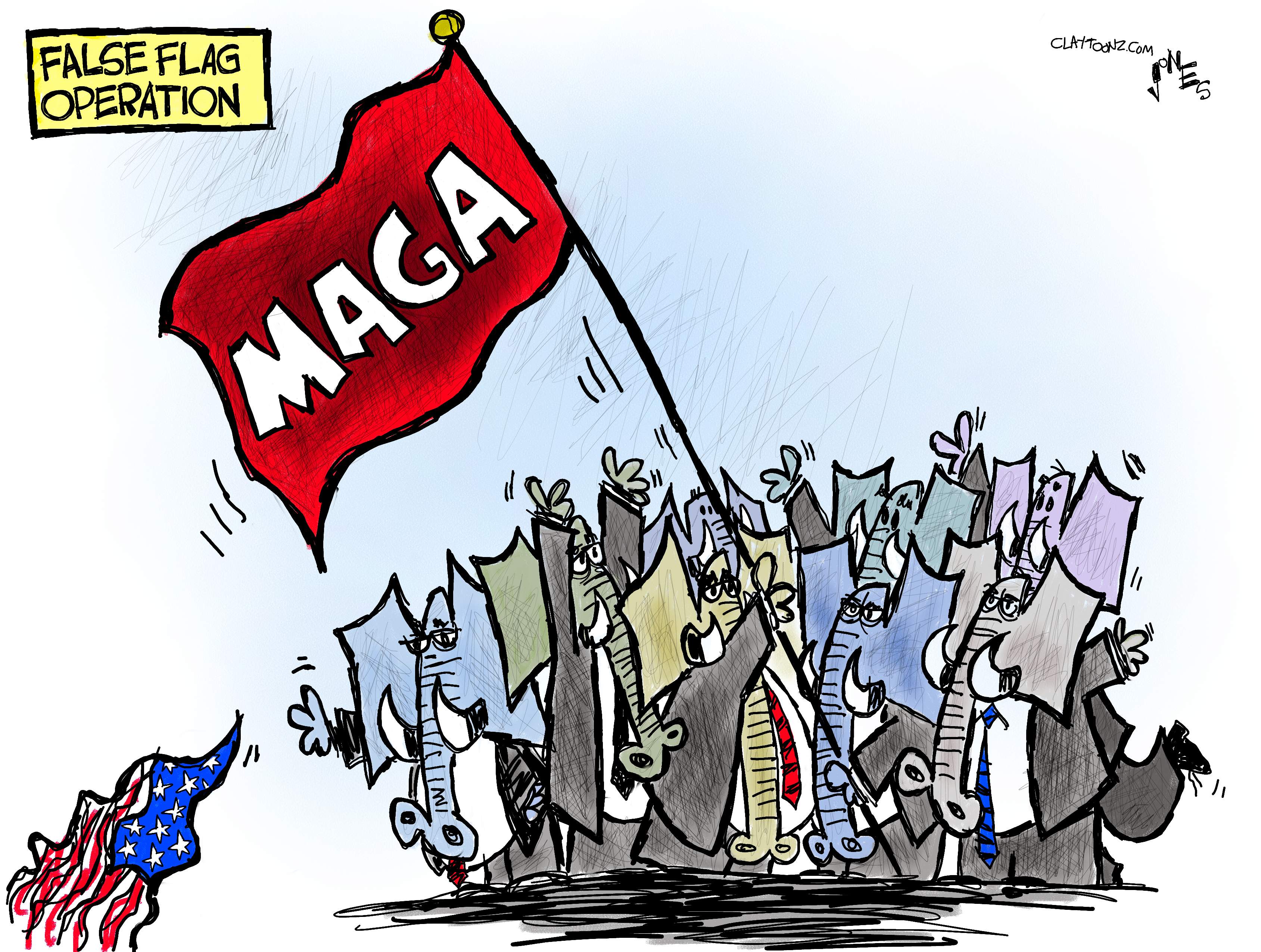
The US is also a central exporter of far-right ideology through its conference circuit. American actors are disproportionately represented in transnational gatherings, with think tanks like the Heritage Foundation and figures tied to Project 2025 carrying MAGA politics abroad [11]. Donald Trump remains the gravitational centre of this ecosystem, his “Make America Great Again” rhetoric supplying both slogans and strategy to partner overseas. Figures like Charlie Kirk, founder of Turning Point USA, amplify the effect. SPLC’s 2024 Year in Hate & Extremism shows Kirk openly celebrating “Great Replacement” conspiracy narratives and rallying youth through TPUSA around immigration and “native-born Americans” rhetoric [10]. Kirk’s organisation, TPUSA, also cultivates deep reach among students via chapters in high schools and universities across all 50 states, which positions him not just as a domestic influencer but as a nodal point in the export of MAGA style nationalism [29].
Germany
Germany’s Alternative für Deutschland (AfD) is not merely reacting to domestic economic and cultural anxieties but is now a central node in Europe’s far-right infrastructure. As documented in the GPAHE report, AfD is among the most frequent speakers at conferences across Europe, participating in networked events with other far-right parties and organisations [11]. Its ideological frame — remigration, anti-immigration, defining identity in exclusionary terms — mirrors rhetoric adopted elsewhere via the conference circuit.

Domestically AfD’s rise is also politically consequential. For example, in May 2024 it was expelled from the European Parliament’s Identity and Democracy group after remarks by one of its leaders defending nazi paramilitary force, the SS, which caused other parties in the ID grouping to sever formal ties [23]. Yet even with such controversies, its narratives continue to influence policies and public opinion around migration, border control, and national identity. The pull is not simply xenophobia, but the cohesion and amplification the transnational far-right infrastructure gives them: shared symbols, repeated themes, common enemies.

Italy
Italy under Fratelli d’Italia (FdL) and Lega plays a starring role in the far-right’s international loop. According to Mapping The Far Right, Italian far-right entities (think tanks like Nazione Futura, plus officials from FdL and Lega) show up repeatedly in European far-right conferences, stretching their influence beyond domestic policy [11]. At the same time, there are paradoxes: while public speeches emphasise “fortress Europe,” remigration and strict border policies, economic necessity has led to policy instruments like the Decreto Flussi, which grants work visas to non-EU migrant workers.

More concretely, recent academic work on Italian online extremism shows how far-right discourse (racist, anti-migrant, anti-LGBTQ+) is robustly present in Telegram communities: hate, disinformation, identity contests are being shaped in those spaces and echoing not just domestic debates, but themes echoed in transnational far-right networks [2]. The duality is masked: high-volume circulation of exclusionary rhetoric, paired with active engagement in enabling migrant labour when it suits and economic interests.
France
In France, Marine Le Pen has wrapped strong anti-multicultural rhetoric into her nationalist platform, framing diversity as a threat to national cohesion. Meanwhile, polling data suggest her popularity is rooted in broader public discontent: voters cite immigration (77%) and the cost of living (67%) as primary motivators for their support, indicating that economic anxiety underlines the appeal of her message [14][35].
GPAHE’s report confirms that the transnational far-right conference circuit includes French participation: French groups appear among the organisations involved in forums where the “Great Replacement” conspiracy theory and anti-immigrant rhetoric are shares with speakers from multiple countries [11].

The patterns are strikingly consistent. When structural problems are too vast or entrenched, the far-right offers the seduction of a shortcut. It trades patience for fury, reform for exclusion, complexity for the simple promise of a wall, a ban, or a deportation. The fantasy is always the same: that once borders are sealed and identities purified, everything else will somehow fix itself overnight.
Why This Matters for Youth
- Material futures are on the line.
We are not just inheriting a burden so much as being forced to live inside it. Housing has become speculative property, jobs are stripped of stability, and debt fixes itself to us like a shadow. Culture wars are a gift to governments: they distract from stagnant wages and unrestrained housing cartels while the real fractures deepen. What we lose in that distraction is not theoretical; it is the possibility of building a life without precarity as its foundation. - Civic space shrinks for us first.
When extremism gains ground, the state does not expand freedom, it contracts it. History records the sequence clearly: more surveillance, harsher policing, heavier penalties for dissent. The first to feel this tightening are never the comfortable. It is students, renters and organisers whose gatherings are broken up, whose protests are criminalised, whose futures are sold off to the highest bidder. - Solidarity gets sabotaged.
Scapegoating works because it turns shared struggle into false rivalry. Migrants and young workers belong on the same side of the picket line yet are pushed into competition for jobs and housing as though scarcity — uneven distribution — had not been manufactured. Employers benefit most from this fracture: a divided workforce cannot organise, cannot bargain, cannot resist. What looks like nationalist anger is in practice a subsidy to capital. - Policy imagination collapses.
Structural problems demand structural remedies: building homes, reforming rental law, investing in training and green industries. The far-right offers none of this. Instead, it reduces every crisis to a border, a ban, a deportation. Each rally that settles on immigrants as the culprit is not only hollow, but it also actively narrows the space for serious reform. Political oxygen is finite, and it is being consumed by theatre. - Algorithms do the recruiting.
Platforms reward what keeps eyes on the screen, and anger is the most reliable fuel. A young person who lingers on one grievance clip is quickly fed another, each slightly more extreme, until outrage feels like common sense. Creators learn to game this system, packaging ideology as memes, rants or “just asking questions,” knowing the algorithm will reward provocation. Recruitment is no longer handed out in leaflets on the street; it is built into recommendation engines that turn frustration into identity, and identity into loyalty. - Multicultural life is our normal, and it is at risk.
What we call “multiculturalism” is not a mood. It is working infrastructure. It is the roster at the hospital, the classroom, the research lab, the kitchen where your rent is paid, the music scene that keeps a city alive after dark. It widens the set of people you can learn from, trade with and rely on. Purity politics shrinks that set, turning visas into bottlenecks, classrooms into tests of belonging, neighbourhoods into checkpoints. The cost is paid in slower services, thinner culture, smaller horizons and a public sphere that feels meaner and more suspicious. Before economics and economic justifications, this is first about protecting the everyday commons that makes life workable and interesting. - The opportunity cost is brutal.
Every minute spent blaming migrants is a minute stolen from real solutions. Public housing goes unbuilt while property and real estate empires continue conquering. Fossil fuel companies keep buying politicians and the climate crisis remains on the back burner, alongside green jobs and energy sources. Our schools and hospitals stay understaffed and broken. The far-right does not only misdirect anger, it robs us of time, the most finite of resources. For the young, this is not abstract. Lost years cannot be recovered. Futures delayed are futures denied.
31 August was a stress test. A movement that parades as protector ate from the kitchens it despises, borrowed crowds for propaganda, then broke toward Camp Sovereignty. The housing ledger sits beside that spectacle: supply thin, approvals weak, rents high; none of it shifts when you shout at a border. The choice is stark. Keep trading policy for performance and we inherit debt, unaffordable rent and narrow horizons. Or commit to the work that builds what the slogans only name: homes, wages, equal safety. Refuse scapegoats. Follow the money. Hold power to account.
“The world is in greater peril from those who tolerate or encourage evil than from those who actually commit it.”
Albert Einstein
___________________________________
Reference List
1. Aleman, M & Cano, RG 2025, ‘What to know about the El Salvador mega-prison where Trump sent hundreds of immigrants’, PBS News, 16 March, <https://www.pbs.org/newshour/world/what-to-know-about-the-el-salvador-mega-prison-where-trump-sent-hundreds-of-immigrants>.
2. Alvisi, L, Tardelli, S & Tesconi, M 2025, ‘Mapping the Italian Telegram Ecosystem: Communities, Toxicity, and Hate Speech’, arXiv, preprint, 5 May, <https://arxiv.org/abs/2504.19594>.
3. Australian Bureau of Statistics 2024, Overseas Migration 2023-24, ABS, <https://www.abs.gov.au/statistics/people/population/overseas-migration/latest-release>.
4. Australian Bureau of Statistics 2025, Building Approvals, Australia, ABS, <https://www.abs.gov.au/statistics/industry/building-and-construction/building-approvals-australia/latest-release>.
5. Australian Bureau of Statistics 2025, Latest insights into the rental market, ABS, <https://www.abs.gov.au/articles/latest-insights-rental-market>.
6. Bloomberg News 2025, ‘About 90% of migrants sent to El Salvador lacked U.S. criminal record’, Los Angeles Times, 10 April, <https://www.latimes.com/world-nation/story/2025-04-10/about-90-of-migrants-sent-to-el-salvador-lacked-u-s-criminal-record>.
7. Dempsey, B 2025, What would have been some of the best footage…, Instagram, 14 September, <https://www.instagram.com/share/BA48vqTZ_f>.
8. fight_for_a_future 2025, Brown women chased & intimidated at Tommy Robinson’s far-right…, Instagram, 16 September, <https://www.instagram.com/share/BAV3r9Ofre>.
9. fight_for_a_future 2025, Well well well, Instagram, 14 September, <https://www.instagram.com/share/BATsAUDJGl>.
10. Fugardi, R 2025, Turning Point USA: A Case Study of the Hard Right in 2024, 22 May, Southern Poverty Law Center, Montgomery, <https://www.splcenter.org/resources/reports/turning-point-usa-case-study-hard-right-2024/>.
11. Global Project Against Hate and Extremism n.d., Mapping The Far Right, GPAHE, <https://globalextremism.org/reports/mapping-the-far-right-the-movements-conferences-illuminate-its-growing-transnational-networks/>.
12. Huang, D 2025, ‘Anti-immigration protestors slammed after dining at yum cha restaurant following Sydney rally’, 7NEWS, 1 September, <https://7news.com.au/news/anti-immigration-protesters-slammed-after-dining-at-yum-cha-restaurant-after-sydney-rally-c-19876530>.
13. Hussain, D 2025, What will be the net result of telling 100,000+ people…, Instagram, 14 September, <https://www.instagram.com/share/BA_ZPjUTWR>.
14. Ivaldi, G 2024, A Tipping Point for Far-Right Populism in France, European Center for Populism Studies, <https://www.populismstudies.org/a-tipping-point-for-far-right-populism-in-france/>.
15. Jasmine, A 2025, Stick to your fish chips and beans pls…, Instagram, 15 September 2025, <https://www.instagram.com/share/_wOhJc32Q>.
16. Kelly, C 2025, ‘Australia is a landlord’s market’: rents still at record high despite slow growth, report shows’, The Guardian, 3 April, <https://www.theguardian.com/australia-news/2025/apr/03/australia-is-a-landlords-market-rents-still-at-record-high-despite-slow-growth-report-shows>.
17. Lawless, J & Doye, L 2025, ‘British politicians condemn Elon Musk’s comments at anti-migrant rally’, AP News, 16 September, <https://apnews.com/article/elon-musk-britain-migrants-protest-b1f272511ff0c5bc6a8d7bf308063343>.
18. Le May, R 2025, ‘Neo-nazis in massive crowd of anti-immigration activists dwarfing counter rally in Perth amid national action’, The West Australian, 31 August, <https://thewest.com.au/politics/tensions-mount-as-anti-immigration-activists-flag-wave-through-counter-rally-in-perth-cbd-amid-national-action-c-19861561>.
19. Le Grand, C & Eddie, R 2025, ‘Indigenous leaders call for neo-Nazis’ attack on sacred site to be deemed a hate crime’, The Age, 1 September, <https://www.theage.com.au/national/victoria/politicians-condemn-gutless-attack-by-neo-nazis-on-indigenous-sacred-site-20250901-p5mrc3.html>.
20. Lubin, R 2025, ‘‘The United States wants you to leave’: Unaccompanied migrant kids are being forced to attend deportation hearings alone’, The Independant, 25 April, <https://www.independent.co.uk/news/world/americas/us-politics/migrant-children-deportation-hearings-b2739754.html>.
21. Martino, M 2025, ‘How Neo-Nazis used protesters for their own propaganda’, ABC News, 8 September, <https://www.abc.net.au/news/2025-09-08/march-for-australia-neo-nazi-propaganda-anti-immigration/105741154>.
22. McIlveen, E 2025, ‘‘Racist and proud’: Neo-Nazis attempt separate march down Sydney’s King Street’, news.com.au, 31 August, <https://www.news.com.au/national/neonazis-brawl-with-rightwing-figures-at-melbourne-march-for-australia-rally/news-story/3aa68f68529ea39488b34f8d18959939>.
23. Mendoza, D 2024, ‘Far-Right EU parliament group expels Germany’s AfD over Nazi comments’, Semafor, 24 May, <https://www.semafor.com/article/05/22/2024/germany-afd-italy-maximilian-krah-europe-giorgia-meloni>.
24. National Housing Supply and Affordability Council 2025, State of the Housing System, 21 May, Australian Government, Canberra, <https://nhsac.gov.au/sites/nhsac.gov.au/files/2025-05/ar-state-housing-system-2025.pdf>.
25. Noroozinejad, E 2025, ‘Australia is forecast to fall 262,000 homes short of its housing target. We need bold action’, The Conversation, 22 May, <https://theconversation.com/australia-is-forecast-to-fall-262-000-homes-short-of-its-housing-target-we-need-bold-action-257246>.
26. Quinn, B 2024, ‘Group that emerged from Tory party hosts forum for Britain’s far right’, The Guardian, 25 October, <https://www.theguardian.com/politics/2024/oct/25/traditional-britain-group-conservatives-far-right-uk>.
27. Reserve Bank of Australia 2025a, Statement on Monetary Policy August 2025, RBA, <https://www.rba.gov.au/publications/smp/2025/aug/pdf/statement-on-monetary-policy-2025-08.pdf>.
28. Salomon, G 2025, ‘A US citizen was held for pickup by ICE even after proving he was born in the country’, AP News, 19 April, <https://apnews.com/article/us-citizen-held-ice-florida-law-4b5f5d9c754b56c87d1d8b39dfedfc6c>.
29. Sky News 2025, ‘What is Turning Point USA – the MAGA movement founded by Charlie Kirk’, Sky News, 11 September, <https://news.sky.com/story/what-is-turning-point-usa-the-maga-movement-founded-by-charlie-kirk-13428550>.
30. Stacey, K 2025, ‘Members of far-right party organising asylum hotel protests across UK, Facebook posts show’, The Guardian, 23 August, <https://www.theguardian.com/uk-news/2025/aug/23/members-of-far-right-party-organising-asylum-hotel-protests-across-uk-facebook-posts-show>.
31. SQM Research n.d., Residential Vacancy Rates – National, SQM Research, <https://sqmresearch.com.au/graph_vacancy.php?national=1&t=1>.
32. Taylor, H 2025, ‘Neo-Nazis march through Melbourne CBD in terrifying display of racism ‘recruitment”, 7NEWS, 9 August, <https://7news.com.au/news/neo-nazis-march-through-melbourne-cbd-in-terrifying-display-of-racism-recruitment-c-19629185>.
33. Vinter, R, Gecsoyler, S, Pidd, H & Ahmed, A 2025, ‘Far-right London rally sees record crowds and violent clashes with police’, The Guardian, 15 September, <https://www.theguardian.com/uk-news/2025/sep/13/unite-the-kingdom-far-right-rally-london-tommy-robinson-police-assaulted>.
34. Viscous, S 2025, So there we have it…, X, 29 August, <https://x.com/TridentsNot/status/1961333992814444635>.
35. Viscusi, G 2017, ‘Marine Le Pen calls multiculturalism a weapon for Islamic extremists’, The Sydney Morning Herald, 11 April, <https://www.smh.com.au/world/marine-le-pen-calls-multiculturalism-a-weapon-for-islamic-extremists-20170411-gvi6vz.html>.
36. Vitalli, Y, Yann, T & Mcdill, S 2025, ‘Police and protesters scuffle as 110,000 join anti-migrant London protest’, Reuters, 14 September, <https://www.reuters.com/world/uk/police-protesters-scuffle-110000-join-anti-migrant-london-protest-2025-09-13/>.
 The Young Economist Initiative
Leave a comment